
Fire safety for London shops and retail units
Your occupants are strangers who came in through one door and will head back to it. Everything below follows from that, and from the fact that the staff who have to move them changed twice this year.
Free survey and a written quote, with a reply within 24 to 48 hours.
- BS 5839-1 · trading hours and the public
- BAFE SP203-1 (fire alarms)
- Fike registered
- C-TEC certified
Book a free retail survey
Step 1 of 3Four questions. Free survey, free written quote, no obligation.
Request received
Thanks, we'll call you within 24 to 48 hours to arrange your free survey.
- Service
- We'll call
What happens next
- An engineer calls you to arrange a time, within 24 to 48 hours.
- We survey the building free of charge and put the price in writing.
- You decide once you have the quote. No obligation either way.
Need us sooner? Call 020 3393 1661Mon to Fri 9am–7pm · Sat 10am–3pm



What a retail unit needs from us
A shop fails on the door and the drill far more often than it fails on the detection.
-
The exit that is actually usable
We check every escape door the way an inspector does: can a customer at the back of the shop open it, immediately, in the direction of escape, with nobody helping them.
-
The stockroom treated as the risk it is
Most of the combustible material, most of the chargers, and often the escape route. It is the reason a shop is usually L2 rather than L3.
-
Extinguishers matched to what is in the unit
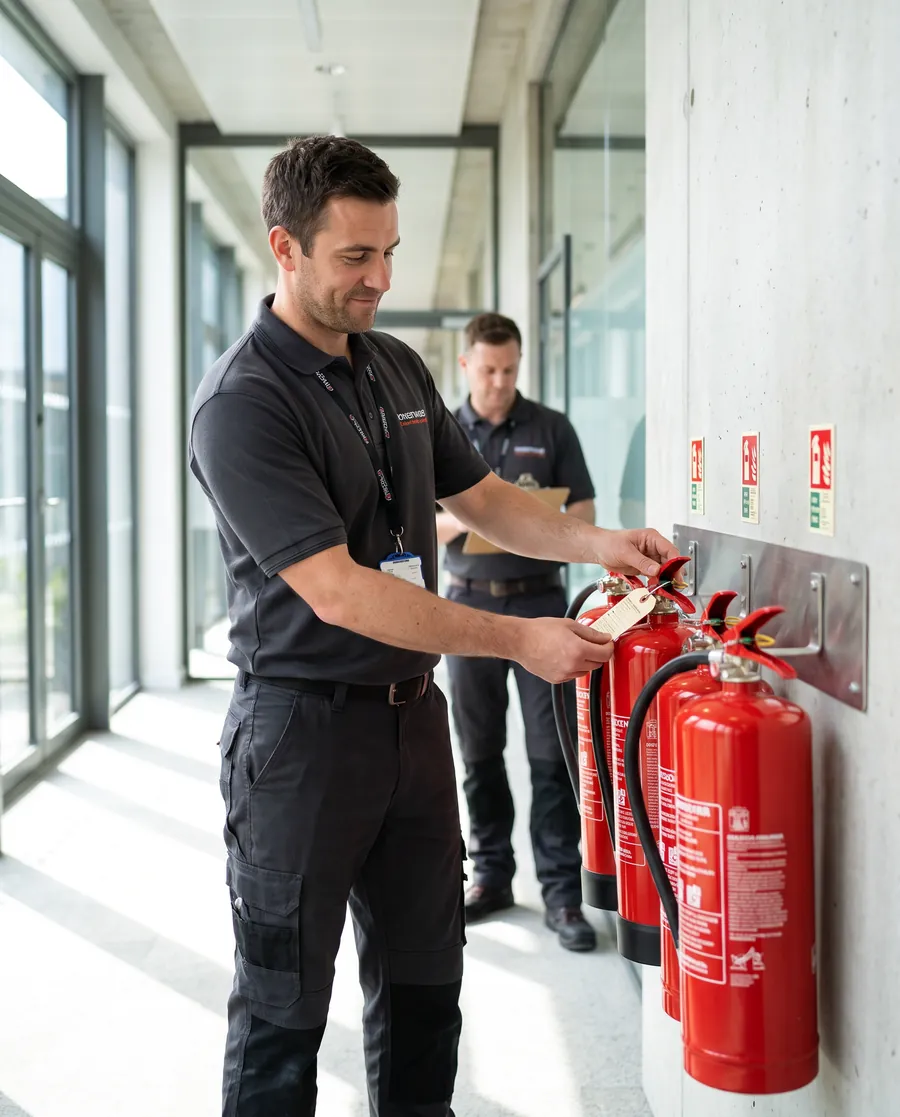
Sited and selected to BS 5306-8, serviced to BS 5306-3. If what you already have is adequate, we say so.
-
Training that survives your turnover
Written for the person working alone on a Sunday, not for a manager who has been there four years. Recorded, so you can show who was trained and when.
The clause a shutter breaches
Article 14 of the Fire Safety Order is short and it is the one retail gets caught by. Emergency routes and exits must be kept clear, and doors on them must be capable of being opened easily and immediately by any person who may need to use them, in the direction of escape.
Three things routinely fail that test in a London shop. A rear exit with a mortice lock and the key on a hook behind the till, because the person who needs it may be a customer forty feet from the till. A shutter half-down at closing while staff are still cashing up and a delivery is being taken. And stock stacked into a corridor that measured fine at the survey and does not measure fine in the fortnight before Christmas.
None of those are detection problems, and no alarm system fixes any of them. They are the first things we look at, because a unit with perfect detection and a locked exit is worse off than the reverse.
What fails in retail
- Keyed rear exits
- Replaced with a panic bar, or a green-break release with a door contact where security is genuinely the concern.
- Shutters during trading
- The escape route has to work whenever anybody is on the premises, including while cashing up.
- Corridor storage
- Measured at the survey and again at peak. Escape width is not a Christmas variable.
- External discharge
- If the exit lets out into an unlit yard, that yard needs emergency lighting too.
- Every escape door openable immediately, by anyone, without a key
- Escape route width checked at peak stock, not just at survey
- Stockroom detected as a named high-risk area where the assessment calls for it
- Emergency lighting over the exit route and any external area it discharges into
- Extinguishers selected to BS 5306-8 for what is actually in the unit
- Enough trained staff for every shift pattern, including lone working
- The shopping centre interface agreed in writing before anything is specified
- A drill that has actually been run, and a record that says when
How a retail survey runs
We start at the back door and work forwards, which is the opposite of how most quotes are produced.
-
01
The escape route first
Every door on it, opened, from the direction a customer would come. This takes ten minutes and settles most of the assessment.
-
02
The stockroom and the electrics
Where the material and the ignition sources actually are, and whether the escape route runs through them.
-
03
The shift pattern, not the headcount
Who is on at the quietest hour, and whether that person could evacuate the unit alone.
-
04
A written position
What is required, what is already satisfied, and what is a housekeeping change that costs nothing.
What shop owners and area managers ask us
Can we keep the fire exit locked while we are trading?
No, and this is the most common enforcement point in retail. Article 14 of the Fire Safety Order requires that emergency exits can be opened easily and immediately by any person who may need to use them, in the direction of escape, whenever anybody is on the premises. A key behind the counter does not satisfy that, because the person who needs the door may be a customer at the back of the shop and the key may be in a pocket that has gone to the stockroom. Where security is the genuine concern, the answer is a panic bar with an alarmed door contact, or a green-break emergency release, not a lock.
How many staff need fire training if the shop only has three people on?
Enough competent people to implement the evacuation procedure, which in a small shop usually means everyone who works a shift alone or in charge. That comes from Article 15 of the Fire Safety Order rather than from a separate marshal law, which is why nobody can tell you a fixed number. The practical test is whether the person on the floor at four o’clock on a Sunday knows what to do, where the exits are, how to sweep the fitting rooms and where the assembly point is. Retail turnover means this needs re-doing far more often than most other sectors, and a record of who was trained and when is part of it.
Do we need detectors in the stockroom or just the shop floor?
The stockroom is normally the reason a shop is not a simple system. It holds most of the combustible material, it is often where the electrics and the chargers live, it is unoccupied for long stretches, and in many units the fire exit route runs through it. That combination makes it the named high-risk area which takes a system from L3 to L2. It is also the room where a fire will develop unnoticed for longest, which is the whole argument for detecting it rather than relying on somebody smelling smoke from the till.
Our unit is in a shopping centre. Who is responsible for what?
The centre management is normally the responsible person for the malls, the service corridors and the centre’s own alarm and evacuation strategy, and you are the responsible person for your unit. The centre will usually require your system to interface with theirs so that an activation in your unit is known to their control room, and their evacuation strategy may be phased rather than simultaneous. Ask for the strategy and the interface requirement in writing before any work is specified, because a system that cannot talk to the centre’s panel will have to be revisited.
What about the extinguishers, and how many do we actually need?
Siting and selection come from BS 5306-8 and the servicing from BS 5306-3, and the number follows from what is in the unit rather than from its floor area alone. A shop with a stockroom, a small kitchen area and a bank of chargers has three different fire types to cover, so the answer is rarely "two water extinguishers by the door". We work it out on the survey and tell you if what is already installed is adequate, which it sometimes is.
Where this comes from
- BS 5839-1, fire detection and alarm systems in non-domestic premisesBSI
- BS 5306-3, commissioning and maintenance of portable fire extinguishersBSI
- BAFE, the third-party certification body for scheme SP203-1bafe.org.uk
We name the standard rather than quoting it. British Standards are copyright of BSI and have to be bought from them; the links above are to the publisher so you can check any figure on this page against the source.
Free survey · No obligation
Start with the back door
It is the fastest way to find out where a retail unit really stands, and it is the first thing we check. The survey and the written quote are both free.
- BAFE SP203-1 registered for fire alarms, Fike and C-TEC certified
- Written quote before any work starts
- Called back within 24 to 48 hours